Healthcare facilities strive for optimization, especially when people's lives are at stake. As part of their daily operation, and a key component of ensuring utmost success in their goal, attention to healthcare air purification should be closely monitored and addressed. Improving indoor air quality and infection prevention is essential to creating safer healthcare environments, reducing the spread of airborne contaminants, and supporting better patient outcomes through effective HEPA and UV-C air purification solutions.
HEPA UV-C air purification systems for healthcare are highly sought after for their ability to purify indoor air up to 99.99%. Acting as an added layer of disinfection and infection control, UVC targets airborne pathogens that are microscopic in size, and that are not initially captured by the first line of defense, the HEPA filter.
Healthcare professionals work hard where it matters. While they put forth every effort to save lives daily, it is up to us to provide solutions that help support and elevate their mission – working behind the scenes to make the environment a safer place for those who are already vulnerable entering for care. Let’s make it count with a highly effective and powerful dual-action defense healthcare air filtration system.
The Importance of UVGI Together with HEPA Filtration for Airborne Infection Control
A powerful duo indeed. HEPA filtration and UVGI (ultraviolet germicidal irradiation) in a single system help to target the majority of environmental elements and biological contaminants that otherwise would be harmful to one’s health.
Indoor air quality continues to sit at the epicentre of discussion, particularly within healthcare environments, where cleaner air and effective infection prevention measures remain critical to protecting patients, healthcare professionals, and visitors.
Exposure to airborne infections, specifically from healthcare environments, poses a risk for those who seek medical intervention in these facilities. One doesn’t typically consider that they may walk out of the hospital or other healthcare facility with a secondary health concern when they go in to heal their primary illness.
UVC acts as a supplemental air-cleaning measure to HEPA. UVC technology, already used for centuries in hospitals, works to inactivate the molecular structure of the airborne pathogen, preventing it from multiplying. Eventually, the microorganisms will diminish in number and finally won’t exist in the air that you breathe.
Although medical-grade HEPA filters are excellent solutions for improving indoor air quality, alone, they are unable to tackle all airborne pathogens. The efficiency of medical-grade HEPA filters is 99.95%. When adding an extra layer of purification, such as UVC, air purification systems are able to achieve 99.99% efficiency. It is this dual action that keeps viruses and bacteria at bay and keeps healthcare patrons safe.
Key Applications in Healthcare
- In-Duct HVAC Systems: in this application, the UV-C lamp is installed directly inside the heating, ventilation, and air conditioning (HVAC) ducts to neutralize viruses, fungi, and bacteria as the air circulates in the building.
- Upper-Room UVGI: fixtures mounted near the ceiling (typically 7 feet or higher) disinfect air in the upper part of the room with the use of fans to continuously cycle air past the light. The Government of Canada explains the evidence and safety of UVGI in reducing SARS-CoV-2 in occupied rooms.
- Portable UV Air Cleaners: Standalone units that combine mechanical filters (such as HEPA) with UV-C chambers to scrub and sanitize the air inside high-risk areas like patient rooms, ICUs, and ERs.
Upper-room UVGIs, or ceiling fixtures, offer the greatest advantage for everyone involved. Unlike portable units that take up valuable floor space and can obstruct movement during high-intensity medical procedures, ceiling-mounted fixtures deliver effective air purification while preserving an unobstructed, efficient, and safe clinical environment.
However, not all units are built alike. Allanson’s AirGuard C600 Ceiling HEPA plus UVC Air Purification unit, for instance, blends seamlessly with existing drop ceiling tiles, bypassing the bulk that accompanies most other units. Out of the way and out of sight, AirGuard C600 safely and effectively purifies the indoor air up to 99.99%. Allanson’s hybrid system combines the benefits of medical-grade HEPA filtration, along with powerful UVC technology for hospital airborne infection prevention.
Designed for a wide range of healthcare settings—including patient rooms, isolation rooms, waiting areas, operating rooms, emergency departments, dental clinics, and long-term care facilities—the AirGuard C600 delivers continuous air purification and sanitization to help maintain cleaner air throughout the entire space.
Benefits and Effectiveness of UVGI
- Pathogen Inactivation: Effectively deactivates up to 99.9% of common airborne viruses and bacteria. Combined with HEPA filtration, it improves indoor air quality up to 99.99%.
- Reduction of Healthcare-Associated Infections (HAIs): Studies show that implementing UV-C air and room disinfection strategies can significantly lower microbial air counts and reduce infection rates in hospital units. As stated in the Journal of Hospital Infection on ScienceDirect.com, a notable study by Ethington et al. examined the effect of UV-C air disinfection in an ICU over the course of a year [20]. The installation of a UV-C air disinfection device led to a 42% reduction in microbiological air contamination, a significant improvement in the hospital environment's overall cleanliness.
- Chemical-Free Operation: Provides continuous or automated microbial control without adding chemical disinfectants or generating toxic emissions. Air disinfection without the threat of harmful chemicals provides peace of mind and a healthier outcome.
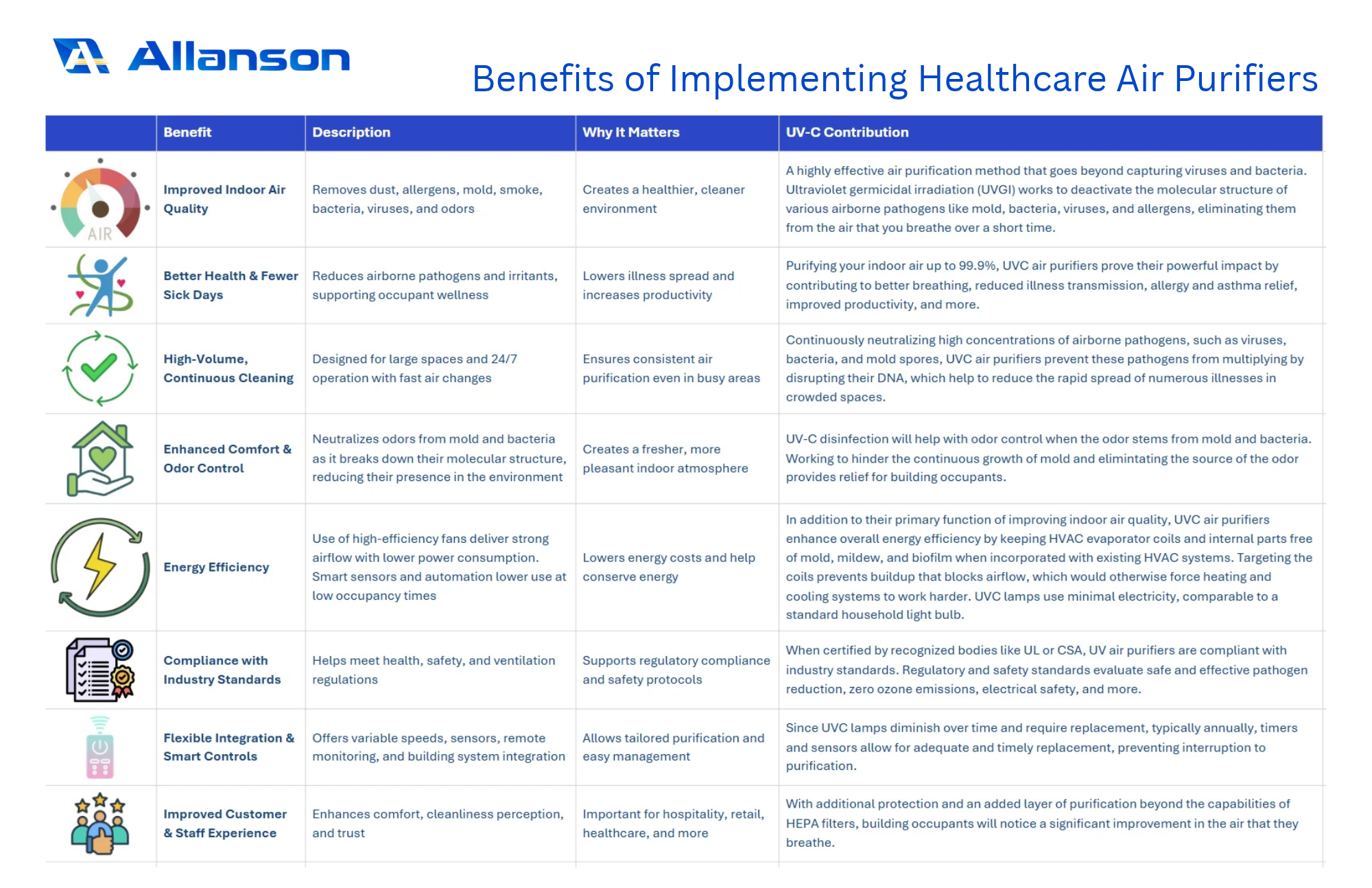
UVC technology has countless impacts. Let’s explore some of its contributions below.
Click here for larger view of chart.
When searching for the best air filtration system for your healthcare facility, take into account a number of key factors, which we discuss in our “Commercial Air Purification” blog, that may impact your decision. Filtration efficiency, clean air delivery rate, filter size, noise levels, and control flexibility are just a few product specifications that help determine whether an air purification system is suitable for your healthcare environment.
Allanson’s AirGuard C600 HEPA plus UVC Ceiling Fixture meets the demands of healthcare environments, combining quiet operation with powerful air purification to support cleaner, healthier indoor air. Improve your indoor air quality today!